

pregleda
Theory of Capital Reproduction and Accumulation
| Cena: |
| Želi ovaj predmet: | 7 |
| Stanje: | Polovan bez oštećenja |
| Garancija: | Ne |
| Isporuka: | Pošta CC paket (Pošta) Post Express Lično preuzimanje |
| Plaćanje: | Tekući račun (pre slanja) Lično |
| Grad: |
Beograd-Zvezdara, Beograd-Zvezdara |

ISBN: 0919946003
Godina izdanja: 1975
Jezik: Engleski
Autor: Strani
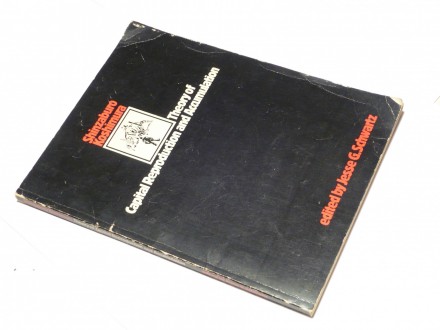
Shinzaburo Koshimura - Theory of Capital Reproduction and Accumulation
DPG Pub. Co., 1975
161 str.
meki povez
stanje: dobro, pečat na predlistu.
Edited by Jesse G. Schwartz. Translated by Toshihiro Ataka.
The Japanese school of economics, from its beginnings, has been profoundly influenced by Marx. Rarely have any of its contributions appeared in English.
This work introduces a powerful stream of thought. Its architectonics are based on Marx`s view of the great cycle of exchange, production, circulation, and accumulation which he crystallized into his schemas of reproduction. This in turn dates back to Quesnay`s `Tableau Économique` which Marx called `the one brilliant idea of which Political Economy has been guilty`. Using this basis, many ideas hitherto only in literary form e.g. `market price` and `monopoly price` are expressed analytically.
It is hoped that this will help young economists everywhere see through the pretensions of `modern economics` which designates as `real` that which can only be counted on the ten fingers of ordinary understanding.
__________________________________________________________
‘In the analysis of economic forms, neither microscopes nor chemical reagents are of use. The force of abstraction must replace both.’
Thus does Koshimura quote Marx in the introduction to his book. But he gives no warning that the process of abstraction, of simplification, of a movement away from the material and historical world in order to concentrate attention on the central factors, is only one side of a two-sided process for making sense of the social world. Marx spends a lot of time in Capital relating his abstract world back to the real events of history and the real motions of the world. This is especially essential to Marx because he sees all social phenomena as being indissolvably part of the material world which men and women shape by their collective efforts. Economic systems built in academic thin air may be logically faultless, but tell us little or nothing about the real world.
Marx could show theoretically that the concentration and centralisation of capital into relatively fewer and fewer, larger and larger units was possible, but only the concrete realities of technology and economies of scale on the one hand, and of crises which bankrupt weak capitals on the other, make the theoretical possibility an historical fact. Likewise with Marx’s contention that there existed a tendency for the rate of profit to fall. Only the positioning of the theory within the complex web of the real world, a world within which national capitals fight for resources and shares of world surplus value, transforms it from an intriguing chimera of doctrinal history into a powerful tool of analysis.
Unfortunately Koshimura’s book, written nearly 20 years ago in Japanese and appearing in English for the first time, studiously avoids any such attempts to locate Marxist theory in the real world. It is the work of an academic Marxist, a mathematical scholastic economist. As such it will be incomprehensible for the most part to readers who do not possess a working knowledge of advanced maths. Basically it represents an early example of an increasing number of attempts to make Marxist economics ‘respectable’ to the world of universities and radical students of bourgeois economics. He sees the main need to give Marxist economics a greater ‘formal coherence’ because, to Koshimura’s ‘greatest regret (it) lags behind modern bourgeois economics’ in this respect. Only in this way can we establish ‘a science of Political Economy’. Not surprisingly therefore the book’s climax is to develop a formal picture of price and profit determination in a system of monopolies. Monopoly dealt with in this formal way is the nearest point the book gets to in reflecting the modern world. Marx is, in the process, reduced to the status of an alternative theory of how prices are formed, despite passing references to his prime concern with the social relationships which underly the functioning of the economic system.
Along the way Koshimura’s total lack of reference to the world about us produces some strange omissions. For example, in chapter seven, on the tendency for the rate of profit to fall, there is no consideration of counter-acting tendencies, either their status within Marx’s model or their relevance today. Nor does he refer to the Luxemburg-Bukharin exchange concerning the overproduction of consumer goods when he relates the rate of profit to the structure of capital reproduction. This is a pity because within the limits he sets upon himself Koshimura writes cogently and coherently (with the notable exception of his chapter five formulation for a uniform rate of profit which even he seems to be aware of).
Marxist economics is very much in need of a work which pulls together a rigorous presentation of analysis with the processes of the material world; particularly at a time when it is fashionable in New Left circles to abandon materialism under the guise of rejecting ‘empiricism’ and produce yet another bastard called ‘revisionism’. This is not that work, nor anything like it.
John Ure
Editor`s Preface
Preface to the English Edition
Preface to the Japanese Edition
Symbols
INTRODUCTION-OUTLINE OF PROBLEMS
Marx`s Contribution to Theories of Reproduction
The Theory of Value
Process of Capitalist Production
Some Assumptions of Marx`s Reproduction Schema
On the Aggregation of Industries into Departments
The Relation between Value and Reproduction
The Labour Theory of Value and Mathematical Method
Productivity and Reproduction
Reproduction and Changes in the Composition of Capital
Capital Turnover and Reproduction
The Process of Reproduction as a Whole
Reproduction and Crises
Task of this Book
CHAPTER I-THE FUNDAMENTAL SCHEMA OF REPRODUCTION
Division of Industries into Two Major Departments
The Value-Composition of Capital and Output
The Fundamental Schema of Simple Reproduction
The Course of Reproduction
The Stability of Simple Reproduction
Reproduction on an Extended Scale
The Fundamental Schema of Expanded Reproduction
The Course of Reproduction
The Condition for the Normal Advance of Expanded Reproduction
The Advance of Reproduction on an Extended Scale
Destruction of Equilibrium
CHAPTER II-MATRIX NOTATION AND THE REPRODUCTION SCHEMA
Division of Industries into Three Departments
The Schema of Reproduction
The Course of Reproduction
Matrix Representation
Conditions for Equilibrium
Circulation among Numerous Industrial Departments
Aggregation into Three Major Departments
Reproduction on an Extended Scale
Conditions for Equilibrium
CHAPTER III-VALUE AND REPRODUCTION
Value and Its Realization
The Value Composition of Products
Numerical Example
Expanded Reproduction
Numerical Example
CHAPTER IV-REPRODUCTION AND SURPLUS-VALUE
The Rate of Surplus-Value
The Expansion of Surplus-Value
Composition of Capital
Capital-Composition and the Rate of Surplus-Value
A Numerical Example
Tendency of the Rates of Surplus-Value to be Equalized
Reproduction with Equal Rates of Surplus-Value
Model of the Schema
Equal Capital Composition and Rates of Surplus-Value
Model of the Schema
Reproduction on an Extended Scale
A Special Case
Model of the Schema
Unequal Degrees of Capital-Composition
CHAPTER V-PRICES OF PRODUCTION AND THE `TRANSFORMATION PROBLEM
Cost Price and Profit
The Rate of Profit
Differences in Capital Compositions and Corresponding Variations in the Rates of Profit
The Formation of an Average Rate of Profit and the Transformation of Commodity-Values into Prices of Production
The Reproduction Schema and Prices of Production
The Method of Bortkiewicz and Sweezy
Capital Composition, the Average Rate of Profit and the Structure of Reproduction
Calculation of the Average Rate of Profit
The General Rate of Surplus-Value
Model of the Schema
Reproduction on an Extended Scale
The Relation between the Rate of Surplus-Value and the Average Rate of Profit
in Expanded Reproduction
Model of the Schemat
A Special Case
Model of the Schema
Average Profit, Value and Surplus-Value
Appendix to Chapter Five-Some Criticisms
CHAPTER VI-DEMAND, SUPPLY AND MARKET PRICES
Market Prices
Demand and Supply
Demand and Supply and Bourgeois Economics
Marx`s View of Demand and Supply
The Range and Limits of the Problem
The Reproduction Schema and Market Prices
The Rate of Sales Profit
Movements of Capital
Simple Reproduction and Market Prices
`Excess` and `Deficit` Capital
Sales Profit and the Coefficient of Over-investment
Relating the Rate of Surplus-Value, the Average Rate of Profit and the Rate of Sales Profit
Numerical Model
Reproduction on an Extended Scale
CHAPTER VII-ON THE FALLING RATE OF PROFIT AND CHANGES IN THE
STRUCTURE OF REPRODUCTION
The Tendency for the Rate of Profit to Fall
What Causes a Rise in Organic Composition
Illustration
Some Effects of the Falling Tendency of the Rate of Profit on the Structure of Reproduction
Disequilibrium and Recovery
Illustration
A Rise in the Rate of Surplus-Value as Off-Setting a Fall in the Rate of Profit
Reproduction on an Extended Scale
CHAPTER VIII-MONOPOLY PRICE AND PROFIT
From Industrial to Monopoly Capitalism
Monopoly Price and Monopoly Profit
The Pursuit of Maximum Profit
The Reproduction Schema and Monopoly Price
Formation of Monopoly in Department I
Monopoly and the Allocation of Social Capital
Formula for the Overall Average Rate of Profit
The Rate of Surplus-Value and the Rate of Profit under Monopoly
The Limits of Monopoly Profit
Model of the Schema
Reproduction on an Extended Scale
Numerical Example
The Case of Monopoly in Department II
Numerical Example
Reproduction on an Extended Scale
The Case of Monopoly in Department III
Expanded Reproduction
Formation of a Partial Monopoly
Conclusions
NAME INDEX
Nonfiction, Mathematical models, Marxian economics, Capital
Plaćanje pouzećem i postnetom za sada nisu opcija.
Lično preuzimanje je isključivo na Konjarniku uz prethodni dogovor.
Hvala na razumevanju.
Predmet: 51960901